
 Mar
30
2026
Mar
30
2026
Legal Migration and the Rights of Foreign Nationals in Focus at the Second Thematic Discussion
On 10 March 2026, the event “Legal Migration and the Rights of Foreign Nationals: Current Situation and Challenges” was held at the Holiday Inn Hotel in Skopje. The event followed the discussion organized on 16 December 2025 and was hosted by the Macedonian Young Lawyers Association (MYLA) as part of the project “Inclusion of Foreigners in the Western Balkans – Access to Social and Economic Rights (FOSTER).” Its objective was to deepen dialogue among state institutions, academia, trade unions, the private sector, and civil society organizations on the challenges related to legal migration and the protection of the rights of foreign nationals in the Republic of North Macedonia.
During the event, the report “Access to Rights for Foreign Nationals in the Republic of North Macedonia,” prepared within the framework of the project, was presented. The presentation was followed by discussions organized into two thematic panels focusing on labour migration and on oversight mechanisms and the protection of the rights of foreign workers.

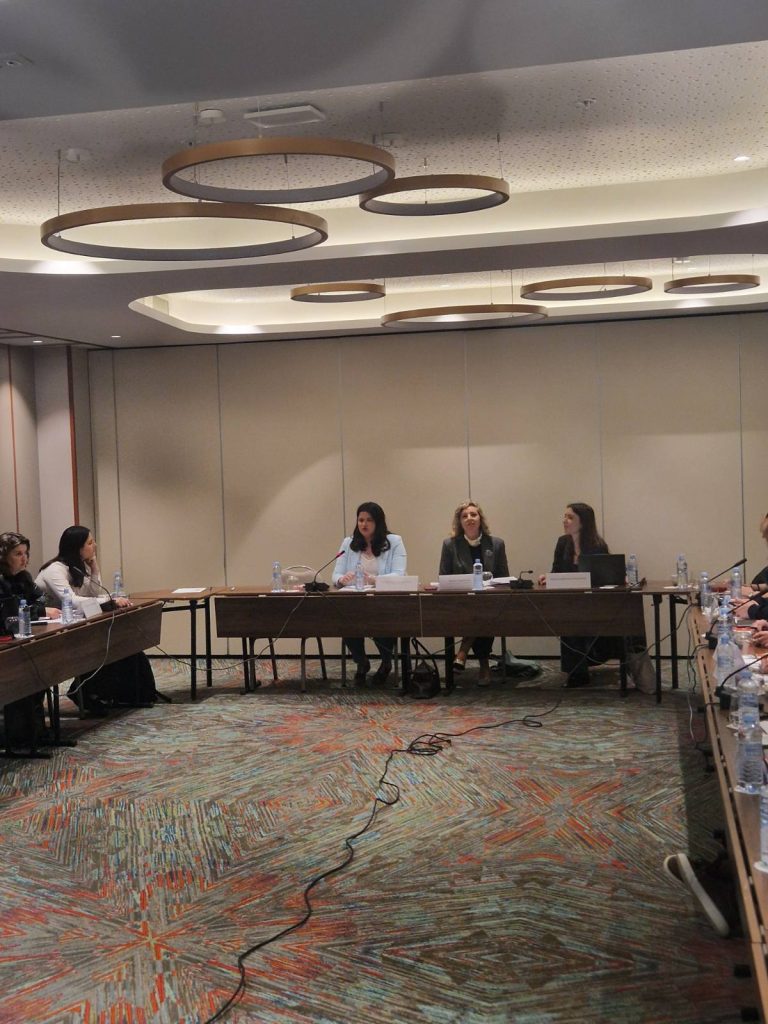
The event brought together representatives of relevant institutions, including the Ministry of Interior (Unit for Foreigners and Readmission), the National Unit for Combating Trafficking in Human Beings and Illegal Migration (Task Force), the State Labour Inspectorate, the Construction, Industry and Design Trade Union of Macedonia (SUTKOZ), the Commission for Prevention and Protection against Discrimination, the Administrative Court, the Skopje Centre for Social Work, and the Ombudsperson Institution, as well as representatives from academia, private companies, and civil society organizations.
The first panel, dedicated to labour migration, presented data demonstrating a significant increase in the number of foreign workers in recent years. The number of registered foreign workers increased from 65 in 2020 to 136 in 2021, 215 in 2022, and 823 in 2023, reaching 2,397 in 2024 and 3,320 in 2025. This trend reflects the growing demand for foreign labour resulting from shortages of domestic workers in certain sectors.
Regarding the composition of labour migration, participants highlighted that, in addition to workers from Türkiye, recent years have seen a growing number of workers arriving from Nepal, India, and Bangladesh. This indicates both a diversification of countries of origin and the emergence of North Macedonia as a destination for workers from a broader Asian region. Temporary labour migration, most often without accompanying family members, continues to be the predominant migration pattern.
It was further noted that, during 2025, authorities recorded 166 foreign nationals who had either left the country or were no longer present at their registered place of residence. The majority were nationals of Nepal (123), followed by India (30) and Bangladesh (13). These figures point to possible secondary migration movements and highlight the need to strengthen monitoring mechanisms and institutional coordination.
The discussion also examined the existing and proposed amendments to the Law on Foreigners aimed at simplifying residence and employment procedures. One provision already in force requires employers to guarantee coverage of the costs associated with the return of a foreign worker in the event that their legal stay is terminated. Additionally, the proposed amendments envisage reducing the deadline for registering an employment relationship from 90 to 30 days, with the deadline commencing from the date the residence permit is issued.
The second panel focused on oversight mechanisms and the protection of the rights of foreign workers. Participants noted that, despite the growing number of foreign workers and international students, the number of complaints submitted remains relatively low, which may indicate insufficient awareness of available rights or limited access to protection mechanisms. Particular attention was devoted to working conditions, especially in the construction sector, where an increasing number of fatal workplace accidents has been recorded, as well as to the limited access of labour inspectors to certain construction sites and the low penalties imposed for identified violations.
The discussion resulted in a number of conclusions and recommendations. Participants emphasized that the increase in economic immigration is directly linked to labour shortages in the domestic labour market, with temporary labour migration without accompanying family members remaining the dominant pattern.
Despite certain legislative improvements, access to employment for foreign nationals continues to be hindered by complex administrative procedures, insufficient digitalisation, and institutional delays. The absence of an integrated migration data management system and the lack of sufficiently disaggregated data further limit the ability to monitor migration trends and develop evidence-based policies.
Additional challenges were identified in the integration process, including lengthy procedures for the recognition of foreign educational qualifications, high costs of translation and certification of documents, language barriers, and administrative delays in issuing student visas and residence permits. Participants also highlighted the absence of centralised data on foreign pupils and students.
With regard to the protection of rights, it was concluded that existing mechanisms remain insufficiently developed, due to the absence of specialised institutional units, limited inter-institutional coordination, and the lack of disaggregated data on reported cases by nationality.
In this context, participants stressed the need to strengthen labour inspection mechanisms, particularly in sectors employing larger numbers of foreign workers, as well as to improve awareness of foreign workers’ rights through multilingual informational materials, enhanced cooperation with trade unions and civil society organisations, and improved access to complaint and reporting mechanisms.
As a key priority, participants also highlighted the importance of strengthening institutional coordination and data exchange among relevant authorities, as well as ensuring the more active involvement of institutions such as the Employment Agency and the Ministry of Economy and Labour in the development and implementation of migration-related policies.